Coastal Humidity and Water Resistance Testing
Salt air does not dissolve a cable sheath; it works on the joints and the damaged spots, where moisture lowers insulation resistance and the current finishes the job. The manufacturer's laboratory list answers that with a water resistance test, and the site also names an AD8 waterproofing rating as one of the regional requirements it highlights. Nine test pages and a ten-item list are the published evidence behind those words, and weathering tests of this kind are arranged on the maker's solar cables.
Key takeaways
- The published laboratory list holds nine test items, from water resistance to construction and dimensional testing.
- The maker also publishes a list of ten tests for PV cables, adding corrosion resistance to the laboratory set.
- The conductor is tinned copper, which gives each fine strand its own corrosion protection.
- KUKA CABLE names an AD8 waterproofing rating among the regional requirements it highlights for PV cable.
What coastal air does to a PV array
A coastal site adds two things to a normal roof: airborne salt and a daily cycle of condensation. Salt deposits are hygroscopic, so they hold moisture against a surface that would otherwise dry. Condensation happens inside enclosures and under clips, where a temperature drop at dusk pulls water out of the air and leaves it sitting against a sheath or a connector barrel.
Neither of those attacks the copper directly while the insulation is intact. They find their way in at the edges: a nick from a rail, a crimp where a strand was lost, a gland that was not tightened. Once water reaches the conductor, the metal corrodes, resistance rises, and the joint runs hotter than the designer intended. That is the chain the published tests are meant to interrupt.
The nine items on the laboratory list
The maker's test pages publish nine checks, all of which are aimed at a different way a cable can degrade. Water resistance sits first in the list, and it is the one that matters most to a coastal installation.
- Water resistance test.
- UV accelerated weather testing.
- Cable abrasion testing.
- Cable cold bending test and cold elongation testing.
- Cable tensile testing after ageing.
- Cable solderability test.
- Static flexibility testing.
- Cable construction and dimensional testing.
Read the list as a set of failure modes rather than as a marketing list. Abrasion covers the rail edge, cold bending covers the winter installation, water resistance covers the coastal site, and dimensional testing covers the possibility that a supplier has quietly reduced a wall thickness.
The ten-item PV cable list
Alongside the test pages, the site publishes a list of the top ten tests for PV cables: conductor resistance, insulation resistance, dielectric strength, tensile strength, heat resistance, flame retardant performance, environmental adaptability, corrosion resistance, and cable connectivity, presented as a numbered article. That list is one entry longer than the collection of individual test pages, and the extra entry is the one a coastal buyer cares about most.
Corrosion resistance has no separate page in the laboratory collection, but the material answer is visible in the construction: the conductor is tinned copper, class 5 flexible to IEC 60228, so every strand carries its own coating rather than relying on an intact surface across the whole bundle. The insulation and sheath are described as electron-beam cross-linked XLPO and LSHF, which do not absorb water the way some fillers do.
Electrical checks that reveal moisture
Two of the ten items catch water that has already arrived. Insulation resistance measures leakage across the dielectric, and dielectric strength measures the voltage the insulation will take before it breaks down. Both move in the wrong direction when moisture is present, which is why they are run rather than assumed. The finished cable also takes a 6.5 kV AC test at 50 Hz for five minutes, and a 10 kV spark test runs during production to catch pinholes before the drum is wound.
The voltage class for the same design is DC 1.8/1.8 kV, with an ambient range of −40 °C to +90 °C and a published bend radius of four times the outer diameter. The design is listed against TUV 2PfG 1169/08.2007, EN 50618:2014 and IEC 62930, and the client describes TUV certification as the starting point rather than the finish. A cable pulled below that radius on a coastal roof is a cable with a thinner wall at the bend, and a thinner wall is the first place water resistance stops being a material property and becomes an installation question.
Published test list against the PV cable top ten
| Test | What it checks | Why a coastal site cares |
|---|---|---|
| Water resistance | Behaviour of the cable in the presence of water | Condensation and spray are constant |
| UV accelerated weathering | Ageing under intense light | Salt haze does not block ultraviolet |
| Cable abrasion | Sheath wear against a hard edge | Rail edges and wind movement |
| Cold bending and cold elongation | Flexibility at low temperature | Winter service work on the array |
| Tensile after ageing | Strength after exposure | Wind load on a long run |
| Construction and dimensional | Wall thickness and diameter | Confirms the published table |
Worked example
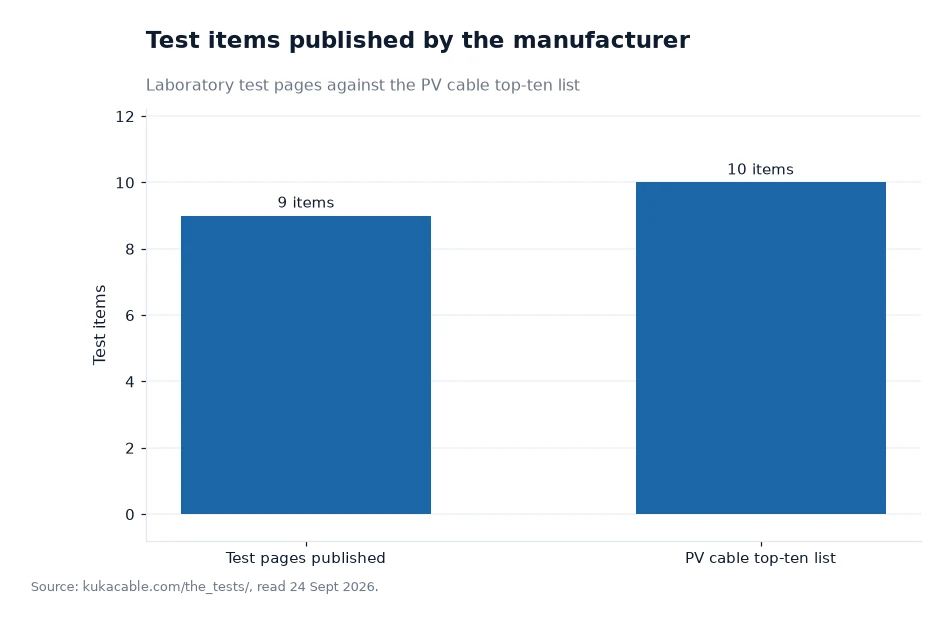
Compare the two published counts. The laboratory collection holds nine test items, and the top-ten list for PV cables holds ten. The difference is one entry, and the missing page is corrosion resistance, which appears on the list without a dedicated test page. That comparison is mine, made by counting the two published sets.
For a coastal project the practical consequence is simple. Nine checks are documented as pages, and the tenth item is answered by the construction: tinned copper strands plus a cross-linked LSHF sheath. When the site does not publish a separate corrosion test result, ask the supplier for the material specification of the conductor and the tinning, and hold the answer against the two other published figures that matter most on a coast, the water resistance test and the AD8 waterproofing rating.
Frequently asked questions
Is a standard PV cable suitable for a coastal or humid installation?
The maker publishes a water resistance test on its laboratory list and names an AD8 waterproofing rating among the regional requirements it highlights, so moisture is part of the design brief rather than an afterthought. The conductor is tinned copper, class 5 flexible to IEC 60228, which protects each strand against corrosion. For a specific coastal site, ask the supplier for the water resistance evidence for the size you are buying.
What is the difference between the nine laboratory tests and the ten PV cable tests?
The laboratory collection publishes nine items, from water resistance through construction and dimensional testing. The top-ten list for PV cables adds corrosion resistance to that group, which brings the total to ten. The extra entry does not have its own test page, so the answer to it comes from the conductor and sheath materials rather than from a separate published result.
Planning for a wet site
Start from the water resistance and UV results, then check the abrasion figure for the route you intend to use, because a coastal roof usually means longer exposed runs and more wind movement. Keep every bend above the published floor of four times the outer diameter, and confirm the conductor construction on the drum label, since tinned copper is the corrosion answer and untinned copper is not the same product. Where a document you need is not published, such as a corrosion test report or a length per drum, ask the supplier and file the reply. The certificates page and the solar cable topic section are the two places to look next.
Water-resistance test names and figures above are published on the manufacturer's own website, with the 24 Sept 2026 read date attached[1].