Comparing Approaches to Planning multi-supplier purchasing
Multi-supplier purchasing is manageable when buyers can see which products depend on which suppliers, what evidence each order requires, and who owns the next decision. A shared request format, integrated schedule, risk-based quality plan, and traceable records help teams compare options without assuming every supplier or product follows the same process.
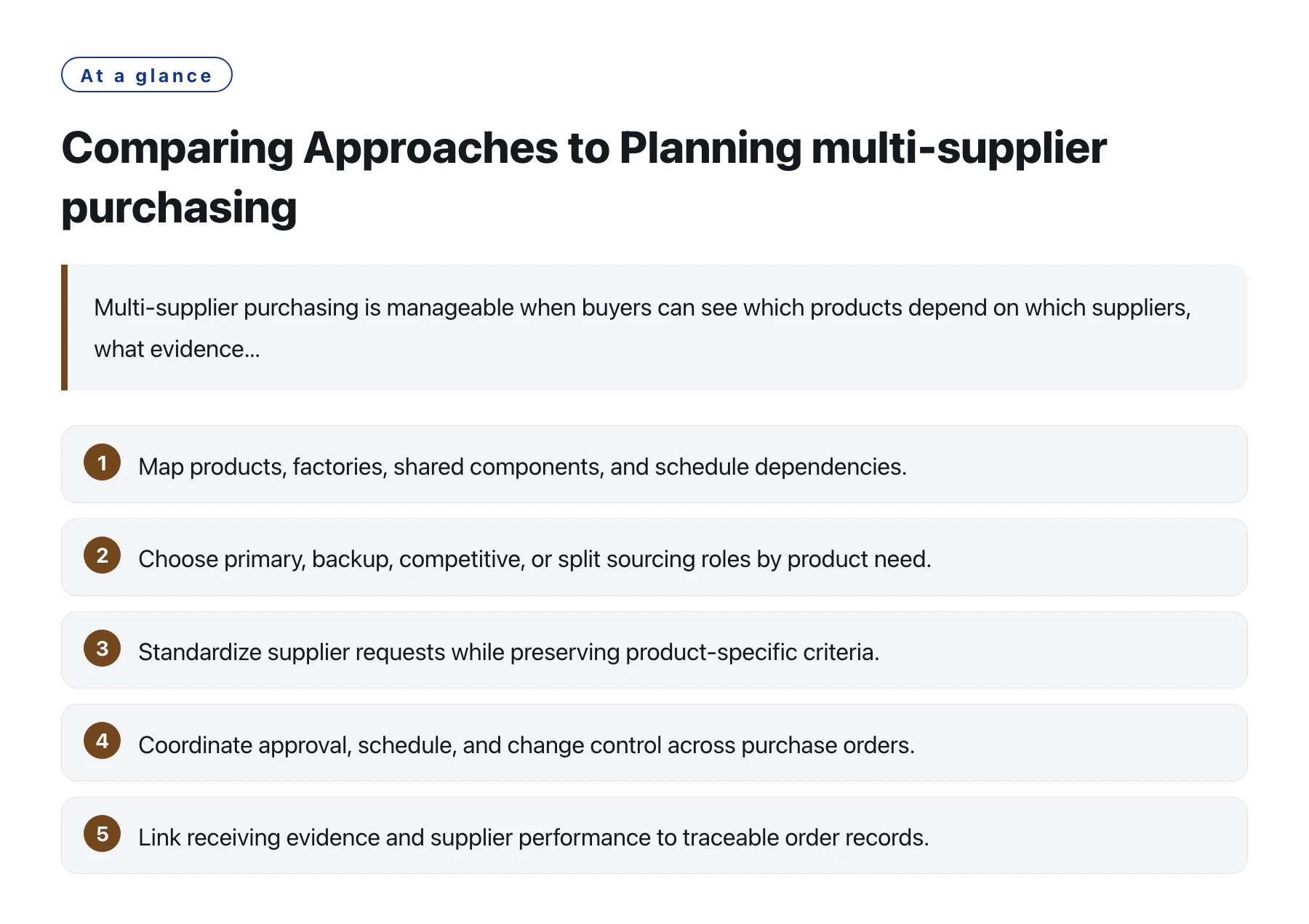
Key takeawaysMap products, factories, shared components, and schedule dependencies. · Choose primary, backup, competitive, or split sourcing roles by product need. · Standardize supplier requests while preserving product-specific criteria. · Coordinate approval, schedule, and change control across purchase orders. · Link receiving evidence and supplier performance to traceable order records.
Planning several suppliers at once is an operations problem as much as a price comparison. The buyer needs a structure that connects each commitment and exception to the product and order it affects.
Map products, suppliers, and dependencies
Begin with a list of products and the suppliers, factories, components, and processes needed to deliver them. Identify shared components, common subcontractors, and dependencies between orders. A disruption at one upstream source may affect several suppliers, while a delay at one factory may hold up a coordinated project. Recording those links helps buyers prioritize follow-up and contingency planning.
Group items by how they are specified and replenished. A standard stocked component may need a different control cycle from a custom product requiring tooling, samples, and engineering approval. Record demand dates, order quantities, minimums, lead-time assumptions, and inventory status. Use the same units and revision conventions across suppliers so the purchasing team can compare commitments reliably.
Identify which requirements are common and which are supplier or product specific. Shared requirements can simplify document review, but copying one supplier’s specification to another product may introduce errors. Maintain an item-level owner and a controlled record of exceptions.
Choose a sourcing allocation strategy
One supplier can simplify communication and consolidate shipments, while several suppliers can provide access to specialized capabilities or alternatives. These tradeoffs depend on product requirements, capacity, risk tolerance, transport, and the buyer’s ability to manage parallel work. Avoid treating supplier count as a goal by itself; choose an allocation that can be monitored and supported.
For each item, state whether the buyer wants a primary source, backup source, competitive quote, or split award. Define the evidence required for each role and when a backup may be activated. A nominal second supplier is not a practical contingency if it has never received the current specification or cannot deliver within the needed schedule.
Compare total delivered and managed cost across options. Include supplier price, inspection, coordination, packaging, freight, handling, customs brokerage, and inventory consequences. Use comparable delivery terms and assumptions. A consolidated shipment may reduce some costs but can also make timing dependent on the slowest ready item.
Standardize supplier requests and approvals
Use a common request package with product identity, specification revision, required quantity, destination, packaging, delivery window, and response deadline. Ask every supplier to return price, currency, validity, capacity basis, schedule, exclusions, and deviations in a standard format. This does not make unlike products identical, but it makes assumptions visible.
Create a responsibility matrix for engineering, quality, compliance, procurement, logistics, and finance. Identify who approves supplier identity, technical alternatives, samples, price, payment, deviations, shipment release, and final receipt. Avoid allowing one department to assume that another reviewed a safety, compliance, or specification question.
The U.S. Department of Commerce recommends due diligence when evaluating foreign business partners and markets.[1] Apply proportionate checks to each supplier, contracting entity, and destination. Keep verified facts separate from supplier statements, identify open questions, and assign an owner to resolve material gaps before an order depends on them.
Coordinate schedules and changes across suppliers
Build one integrated schedule with supplier-specific milestones: specification freeze, quotation, sample approval, material readiness, production start, inspection, cargo readiness, and delivery. Show dependencies such as buyer artwork, tooling approval, or a component supplied by another vendor. Assign planned dates and actual dates so teams can see where slippage begins.
Hold short exception reviews when a supplier misses a milestone or changes a commitment. Record the issue, affected items, schedule impact, mitigation owner, and next decision date. A status report should distinguish a confirmed production date from a target or estimate and should show evidence for any critical claim.
Use a formal change process across the portfolio. When a specification, quantity, source, or destination changes, identify all affected purchase orders and suppliers. Update each controlled document and communicate the effective revision. If a change affects one item but not others, keep the scope explicit so unrelated orders are not altered.
Set quality and receiving controls by risk
Define product-specific acceptance criteria and inspection evidence. A shared checklist may cover document identity, labeling, packaging, and reporting, while tests and defect definitions need to fit each product. State sampling basis, acceptance rules, inspector responsibilities, and escalation steps before production. For higher-risk items, assign specialized review or testing as appropriate.
At receipt, reconcile cartons and quantities against packing lists and purchase orders. Record damage, shortages, lot identifiers, and temperature or handling evidence when relevant. Keep stock on hold until required documentation or inspection decisions are complete. Mixed supplier shipments need labels and records that preserve the link between each package and its source.
Compare supplier performance using indicators the buyer can verify: on-time milestones, defect reports, documentation completeness, change notification, and response to corrective actions. Explain the measurement basis and review exceptions with the supplier. Do not combine unlike product risks into one score that obscures a serious issue on a critical item.
Maintain an auditable supplier portfolio
Keep a current supplier register with legal entity, production site, approved items, contacts, commercial terms, review date, and known constraints. Restrict sensitive information and set access according to team responsibilities. Record when the site or subcontractor changes and when due diligence needs refresh based on risk or policy.
Use a shared purchase dashboard or controlled workbook that links each order to its specification, quotation, approval, inspection, shipment documents, and receipt outcome. Establish naming and revision rules to avoid duplicate files. A dashboard can show status, but source records should remain available for review and correction.
For sourcing coordination and multi-supplier communication in China, buyers may review Shanghai JS Sourcing as one resource. Define whether the support covers supplier discovery, quotation collection, production updates, inspection scheduling, or shipment follow-up, and retain internal ownership for supplier approvals and product release.
Sources
Frequently asked questions
Should a buyer use one supplier or several?
Choose based on product specialization, capacity, resilience, cost, and the buyer’s ability to manage multiple relationships. Define what a primary or backup source must demonstrate.
How can quotations from different suppliers be compared fairly?
Use the same specification revision, quantity basis, delivery point, currency, schedule assumptions, packaging, and response fields. Record each supplier’s exceptions separately.
How should schedule changes be communicated?
Record the affected item and orders, revised milestone, reason, impact, owner, and next decision date. Update controlled documents and send the current revision to every affected party.
What should a supplier portfolio record contain?
Maintain contracting entity and production site, approved items, contacts, key terms, review dates, known constraints, and traceable links to order, quality, and delivery evidence.