OEM Perfume Logistics: The Checklist a First-Time Founder Needs
A manufacturing quotation covers production. It does not cover the part of the project where most first orders lose time, which is everything after the last bottle has been packed. Freight terms, transport documentation, batch records, label review and the final handover each need an owner, and if nobody on the brand side owns them they quietly become the factory's assumption. Treat logistics as a checklist with names and dates attached, not as a task that begins when production ends.
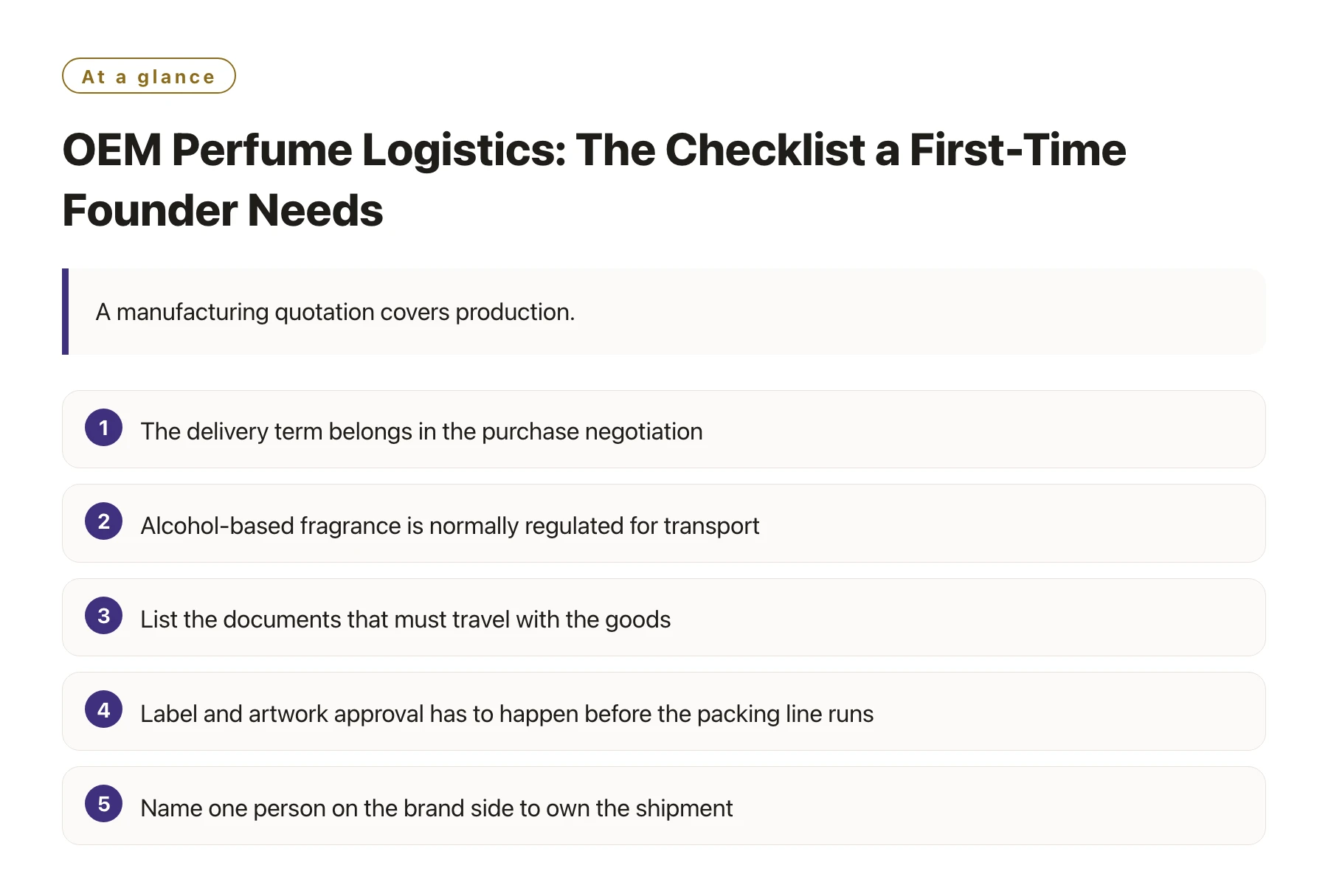
Key takeawaysThe delivery term belongs in the purchase negotiation, because it decides who controls the freight and who carries the risk in transit. · Alcohol-based fragrance is normally regulated for transport, which affects packaging, markings, documentation and which carriers will accept the shipment. · List the documents that must travel with the goods, from batch records to safety data, before the order is placed rather than after it ships. · Label and artwork approval has to happen before the packing line runs, because corrections after sealing mean rework and missed dates. · Name one person on the brand side to own the shipment; decisions made by committee arrive after the freight has already been booked.
A first-time founder usually reads a quotation as a description of a product. It is really a description of a handover: a quantity, a specification, a price, a date and the point at which the factory's responsibility ends. Everything past that point is a second project, with its own vendors, documents and ways to fail.
This checklist walks through that second project for a first OEM perfume order. It assumes you have never arranged an international shipment of a regulated consumer product, and it does not pretend the process is complicated once the steps are written down.
Terms to settle while you are still negotiating
The delivery term belongs in the same conversation as the unit price. Buying ex-works leaves you responsible for collection, export paperwork and carriage. Buying delivered moves more of that to the seller, usually at a higher unit price. Neither arrangement is wrong, but the choice should be made with a freight forwarder already in the room rather than discovered after the order is confirmed.
Ask who handles export documentation and who appears as the shipper. Ask as well, in writing, whether the factory has shipped this exact product format before and to which regions, because a pack that moves easily on one trade lane may be refused by a carrier serving another.
When production is placed with a partner that offers contract perfume manufacturing in China, it is common practice to keep the freight relationship on the brand's own side. That split gives the buyer visibility on a cost line which otherwise arrives as a single unexplained number.
Finally, agree the destination details early: the receiving address, the delivery window, whether the pallets will be accepted on a dock or need a tail-lift, and who signs on arrival. Small receiving facts cause expensive delays when they appear for the first time in a driver's phone call.
The logistics checklist, stage by stage
| Stage | What has to happen | What it requires from you |
|---|---|---|
| Before the order | Choose the delivery term and confirm the destination address and port | A decision, plus a forwarder quote to compare against the quotation |
| Production window | Freeze the specification, fill volume and packaging, and stop changing them | A written approval from the person who owns the product |
| Before packing | Review label and carton artwork against the target market | Documented sign-off rather than a verbal one |
| Before collection | Confirm transport classification and any dangerous goods documentation | Correct packaging, markings and declarations |
| At handover | Collect batch records, safety data and the packing list | A documents folder agreed before the order was placed |
| In transit | Track the shipment and make sure the import broker has what it needs | A named contact on both sides, not a shared inbox |
| On arrival | Clear customs, inspect the pallets and store the goods correctly | A receiving check, not just a signature on a delivery note |
Each row usually belongs to a different person. Write the owner's name next to each one, because the gaps between rows are where first orders stall.
Documents that should travel with the goods
- Batch or production recordsThese connect the delivered units to a specific run, which is the first thing a retail buyer or a market inspector will ask to see.
- Material safety documentationSafety data sheets and any material statements the destination market requires for the fragrance and for the finished product.
- Compliance statements for the finished productDeclarations showing which rules the product was made against for the markets you are shipping into [1].
- Packing list and commercial invoiceValues, quantities, weights and dimensions must match what the forwarder and the customs broker expect, or clearance becomes a conversation.
- Transport classification paperworkAlcohol-based fragrance normally falls under transport rules for dangerous goods, so packaging, labelling and declarations have to follow that classification.
- The approved specificationThe document that defines what was ordered, so the receiving check compares the delivery against a definition rather than a memory.
Three assumptions that cost first-time founders time
That the factory will handle everything
Many factories will, and some do it well. But the services on offer vary considerably, and a delivered price is not the same thing as a managed process. Ask what is included in the quotation and get the answer in writing.
Seeing from formula to finished bottle as a chain of stages makes it much easier to spot where the factory's scope ends and yours begins. The stages do not change because an order is small; they are simply compressed.
That freight can be arranged later
Book too late and the production completion date stops mattering, because the space has gone. On a first order, open the freight conversation when the purchase order is placed rather than when the pallets are shrink-wrapped.
It also helps to look at how examples of fragrance projects are delivered, because the pattern of documents and handover points repeats across project sizes, and the awkward parts are usually the same ones.
That the label can be corrected after production
Artwork has to be approved before the packing line runs. Corrections after sealing mean rework, and rework at that stage usually costs a launch date rather than a small amount of money.
If the label depends on a claim or a certification that is still being confirmed, resolve that before the fill date is fixed. Packaging approval is a gate, not a formality.
Keep one shared folder for the order: specification, artwork approvals, batch records, transport paperwork, packing list and the receiving check. When a question arrives six months later, that folder is the entire answer.
Sources
- European Commission: Cosmetics in the EU —— The European Commission's overview of EU cosmetics rules, including the responsible person, product information file and safety report requirements.
Frequently asked questions
Who usually pays for freight on a first perfume order?
It depends on the delivery term you agree. Ex-works puts collection and carriage on the buyer; a delivered term moves it to the seller, usually reflected in a higher unit price.
Is perfume always classified as dangerous goods for shipping?
Alcohol-based fragrance usually is, because of the alcohol content, but the exact classification and the required paperwork depend on the formulation and the mode of transport. Confirm it with the factory and the forwarder.
How far in advance should we book freight?
For a first order, start when you place the purchase order. Capacity and rates move, and a late booking can wipe out the benefit of finishing production early.
What should we check when the pallets arrive?
Count, condition and identity: quantities against the packing list, visible damage, and batch numbers against the records. Do that before the goods go into storage.
Do we need our own customs broker?
Most importers use one, and many freight forwarders provide or recommend the service. The important thing is to know who is filing the entry before the shipment leaves.